




Archive of our FIRST Seasons
2022: Rapid React
In Rapid React, teams compete to fire oversized tennis balls into the hub at the center of the field. The lower hub is accessible by the robots, but the upper hub requires a launching device to score balls. In the endgame, robots must climb four rungs to get more points the higher they climb.
Game & Robot
2021: Infinite Recharge At Home
2021 was also impacted by COVID. FIRST created At Home Challenges using the 2020 robot. Robot related challenges included 2 shooting challenges, Teleop and Autonomous obstacle course navigation challenges, and an autonomous ball search and intake challenge. FIRST also created a Game Design Challenge where they invited teams to create their own game and an Innovation Challenge where teams were to create a solution to a real world problem based on themes from this years game.
Game & Robot
2020: Infinite Recharge
In Infinite Recharge, two alliances, each with three teams and their trusty droids, attempt to obtain as many points as possible by collecting and scoring power cells into the power ports, completing the requirements for the control panels, and balancing the droids at the rendezvous point to activate the shield generators.
Game & Robot
2019: Deep Space
In Deep Space, two alliances composed of three robots each compete to score as many points as possible by placing kickballs into goals and  securing them with flat circular panels. Teams are also challenged to use camera or vision systems for the first 15 seconds of the match, in which a barrier is lowered between the drivers and the field. At the end of the match, robots can also score points by climbing up a steep staircase.
Game & Robot | Season Recap & Awards
2018: Power Up
In Power Up, two alliances composed of three robots each compete to score as many points as possible by taking command of the Switches and Scale  and placing Power Cubes on them so that they tilt in an alliance-favorable direction. Placing Power Cubes in the Vault can activate Power Ups to help an alliance earn more points or a free climb, which can be used in the endgame, where robots score points by facing the boss of the arcade when they climb the Scale at the end of the match.
Game & Robot | Season Recap & Awards
2017: SteamWorks
In SteamWorks, each alliance’s objective is to prepare the robot (airship) for takeoff. Robots collect fuel (balls) and score it in their boiler via high and low efficiency goals. Boilers turn fuel into steam pressure which is stored in the steam tank on their airship.
Robots deliver gears to pilots on their airship for installation. Once the gear train is complete, they turn the crank to start the rotor.Robots must latch on to their airship before launch (the end of the match) by ascending their ropes to signal that they’re ready for takeoff.
Game & Robot | Season Recap & Awards
2016: Stronghold
In Stronghold, each alliance commands one tower, five defenses, and a ‘secret passage’ which allows their robots to restock on ammunition, called boulders, and crossing defenses scores points. One defense in each alliance’s set of the low bar, is a permanent part of the field. Three defenses are selected strategically by the alliance prior to the start of their match. The final defense changes periodically by audience selection.
Game & Robot | Season Recap & Awards
2015: Recycle Rush
 In Recycle Rush, two alliances of three robots compete to score points by stacking totes on scoring platforms, capping those stacks with recycling containers, and properly disposing of pool noodles, representing litter. In keeping with the recycling theme of the game, all game pieces used are reusable or recyclable by teams in their home locations or by FIRST at the end of the season. Each alliance has two minutes and thirty seconds to score as many points as they can.
Game & Robot | Season Recap & Awards
2014: Aerial Assist
In Aerial Assist, two alliances consisting of three individual teams (red and blue), compete against each other to score the most points. The goal of the game is to put large two foot exercise balls into goals on either side of the arena, while assisting your partners to bring the balls across the field. Points can be score in three ways, successfully putting the game pieces through the goals, making assists with your alliance partners, and shooting the balls over the truss in the middle of the field. Each alliance has two minutes and thirty seconds to score as many points as they can.
Game & Robot | Season Recap & Awards
2013: Ultimate Ascent

In Ultimate Ascent, two alliances consisting of three individual teams (red and blue), compete against each other to score the most points. The goal of the game is to score points by interacting with the field elements and scoring with the game pieces. Points are scored in one of two ways. The first and most common way, will be to successfully shoot or place the game pieces into one of four goals each alliance is allowed to score within. The second way is that robots can attempt to climb up their alliance’s pyramid, earning points based on how far they can ascend. At the end of the 2 minute and 15 second match, the alliance who could score faster and climb the highest receives the most points and is declared the winner.
Game & Robot | Season Recap & Awards
2012: Rebound Rumble
In  Rebound Rumble, two alliances (red and blue), consisting of three teams each, competed to score baskets and balance on bridges in 2 minutes and 15 seconds. The alliance who had scored the most points at the match’s end was declared the winner. The teams could score more points by aiming higher, as there were 4 hoops to score in and, the taller the hoop, the more points it was worth. Also, in the end game (the last 30 seconds), alliances received more points for robots balanced on the bridge.
Game & Robot | Season Recap & Awards
2011: Logomotion
 LogoMotion was played by two competing alliances on a flat 27 by 54 foot field. Each alliance consisted of three robots each. They compete to hang as many inflated plastic triangles, circles, and squares on their grids as they can during a 2 minute and 15 second match. The higher the teams hang their game pieces on their scoring grid, the more points their alliance receives.
Game & Robot | Season Recap & Awards
2010: Breakaway
 Breakaway was played by two competing alliances on a 27 by 54-foot field. Each alliance consisted of three robots. They competed to score soccer balls in the opposing team’s goal during a two minute and 15 second match. The more goals they scored, the more points their alliance received.
Game & Robot | Season Recap & Awards
2009: Lunacy

In Lunacy, six teams, two alliances of three, competed on the crater. The objective was to score the most points in opposing alliances’ trailers. The game was divided into two periods: the autonomous and teleoperated period. The match, including both the autonomous and teleoperated periods, was two minutes and 15 seconds long .
Game & Robot | Season Recap & Awards
2008: FIRST Overdrive
 FIRST Overdrive was played on a game field, called the track, which was carpeted and had the dimensions of 27 by 54 feet. The overpass spanned across the center of the field. Running lengthwise were the lane dividers, a six foot tall structure. The lane dividers were approximately 27 feet long and filled with clear plastic.
Game & Robot | Season Recap & Awards
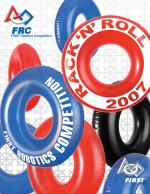 2007: Rack ‘N’ Roll
Rack ‘n Roll pitted two alliances of three teams against one another. The main objective of each alliance was to place tubes onto the center rack.
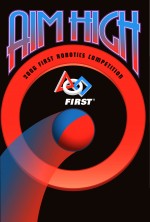 2006: Aim High
Aim High consisted of three teams from two alliances. They had to compete to gain points by delivering balls into goals and by positioning their robots at key locations throughout the field to garner points.
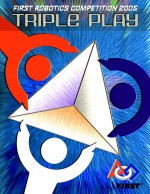 2005: Triple Play
In Triple Play, two alliances of three teams each had to place red and blue game tetra game pieces in or on one or more of the nine goals to score points and claim “ownership” of the goals.
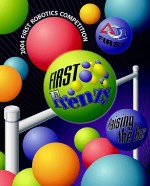 2004: FIRST Frenzy
FIRST Frenzy consisted of two alliances, each with two teams, that had to pass balls to the human players and shoot them into fixed and moveable goals. They competed to score as many of the balls as possible during the two minute and 15 second match.
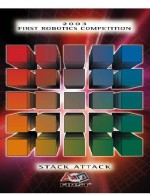 2003: Stack Attack
Stack Attack required a robot to collect and stack plastic storage containers on their side of the playing field. The precise location of the robot, containers, and height of the stacks determined the score for each alliance.
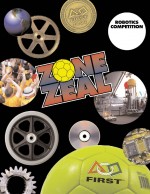 2002: Zone Zeal
In Zone Zeal, two alliances of two teams each competed to move goals and balls into various zones within the playing field. The AdamBots competed in three regional competitions this year. We were 2-5-0 at the Buckeye Regional in Cleveland Ohio. We were 6-4-0 at the Great Lakes Regional at Ypsilanti, Michigan. We were part of the 6th Alliance and lost in a Tie-Breaker in the Quarter finals. We were 4-5-0 at the Midwest Regional at Evanston, Illinois.
 2001: Diabolical Dynamics
Diabolical Dynamics consisted of four teams working together as an alliance to try to achieve as high of a score as possible in each match. All teams on the field shared the same score at the end of the match.
 2000: Co-opertition FIRST
In Co-opertition FIRST, two alliances of two teams each competed to score as many points as possible by placing yellow and black balls into goals.
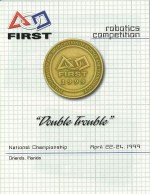 1999: Double Trouble
Double Trouble consisted of alliances of two teams each that had to position “floppies,” robots, and a “puck” on the playing field. Each alliance competed to rack up the most points possible.
Our Robots
2021 Amidala 2.0 – Improved version of Amidala 1.0
2020 Amidala – named after Padme’ Amidala from Star Wars
2019 Valentina – named after Valentina Tereshkova, the first woman in space
2018 Rosalina – means rose
2017 Arabella – means beauty and grace
2016 Valencia – means brave
2015 Anastasia– means resurrection
2014 Andromeda – means ruler of men
2013 Persephone – means bringer of destruction
2012 Margarita – means pearl
2011 Seraphina – means fiery one
2010 Veronika – means bearer of victory
2009 Olympia – means home of the Gods
2008 Amelia – means imitating, rivaling
2007 Arcadia – means place of plenty
2006 Elizabeth – means God is perfection
2005 Victoria – means victor, conqueror
2004 Rogerbot
2003 Penelope – means duck, weaver
2000 Golden Eyes
